





OS Transport Network
OS Transport Network is a rich, powerful dataset, generated from Ordnance Survey's National Geographic Database (NGD). For anyone needing reliable transport network data across Great Britain, OS Transport Network provides routing, speed and restriction information for roads, paths, rail and ferry networks.
The OS NGD Transport products replace the OS MasterMap Highways product range, which will be discontinued in Autumn 2027 – we recommend migrating to OS Transport Network as soon as possible, to ensure continuity.
For migration assistance or questions, please get in touch.
What can OS Transport Network do for me?
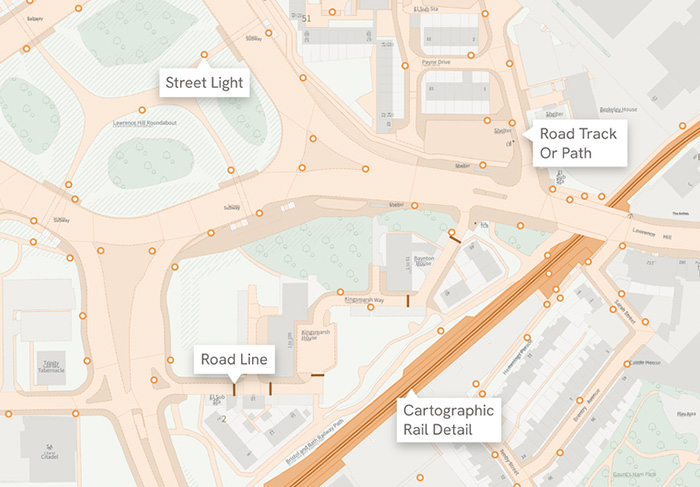
OS Transport Network helps you understand how people, vehicles and goods move across Great Britain. It provides a connected link-and-node network for roads, paths, railways and ferry routes, allowing you to analyse routes, restrictions, access, speed and supporting transport assets.
The data is structured around links and nodes. Links represent segments of roads, paths, railway lines or ferry routes between junctions or nodes. Road links can include road names, street names, pavement, tram and street lighting markers. Path links can also include street lighting markers, helping you build a more complete view of the transport environment.
This makes OS Transport Network useful for planning, routing, active travel, public policy, asset management, environmental assessment and operational decision-making.

Key Features of OS Transport Network
• Road, path, rail and ferry networks: OS Transport Network provides connected network data across multiple transport modes, supporting wider analysis of movement and connectivity.
• Link-and-node structure: Network data is presented as links and nodes, making it suitable for routing, analysis and integration into GIS workflows.
• Road and street naming: Road network data is attributed with road names and street names, with road nodes sometimes attributed with junction names.
• Active travel support: Pavement, cycle lane, path and street lighting data can support safer route planning, walking and cycling strategies, and Local Cycling and Walking Infrastructure Plans.
• Routing and Asset Management Information: RAMI adds routing, restriction and asset management detail, including access restrictions, manoeuvres, physical road characteristics and highway authority responsibilities.
• Speed information: OS NGD Average Speed and OS NGD Indicative Speed products provide speed data by day of week and time of day, including average speeds and indicative speed limits for roads.
• Street works and asset management: RAMI can help identify protected streets, associated conditions, restoration requirements and the authority responsible for road maintenance.
Why should I choose OS Transport Network?
• Transport planning: OS Transport Network supports the identification and planning of new transport routes, including passenger and freight connections.
• Active travel and safer routes: Street lighting, pavement and cycle lane data can help identify poorly lit areas, support home-to-school routing and improve planning for walking and cycling.
• Evidence-based policymaking: The data in OS Transport Network can help create statistics for school transport allocation, funding distribution and sustainable transport policy targets.
• Emergency and incident response: RAMI supports route planning by providing detail on hazards and restrictions, such as dangerous bends, low bridges, one-way streets and road widths within urban areas.
• Asset management: RAMI provides information about road maintenance responsibility, restoration requirements after street works and unusual conditions stipulated by local highway authorities.
• Risk and travel time analysis: Average speed and indicative speed data can help to assess journey times at different periods of the day and understand speed-related risk.
• Street works management: Bus lane and cycle lane data can support asset management and help organisations understand the impact of planned works.
OS Transport Network – Technical Data
Data Structure: Vector - topologically structured link and node network.
Attributes: Road names, street names, junction names where available, routing restrictions, asset management information and supporting transport attributes.
Update Frequency: Quarterly.
Coverage: National (Great Britain).


Unique Identifiers: Primarily uses OSIDs (UUIDs) for features and nodes, with TOIDs available for legacy compatibility.
Data Access: Available via download and API, with options for true area-of-interest selections, Change-Only Updates (COU), and attribute-based filtering.
Data Formats and Supply Options: OS Transport Network can be supplied in CSV, GeoJSON, or GeoPackage formats.
OS NGD Path Network
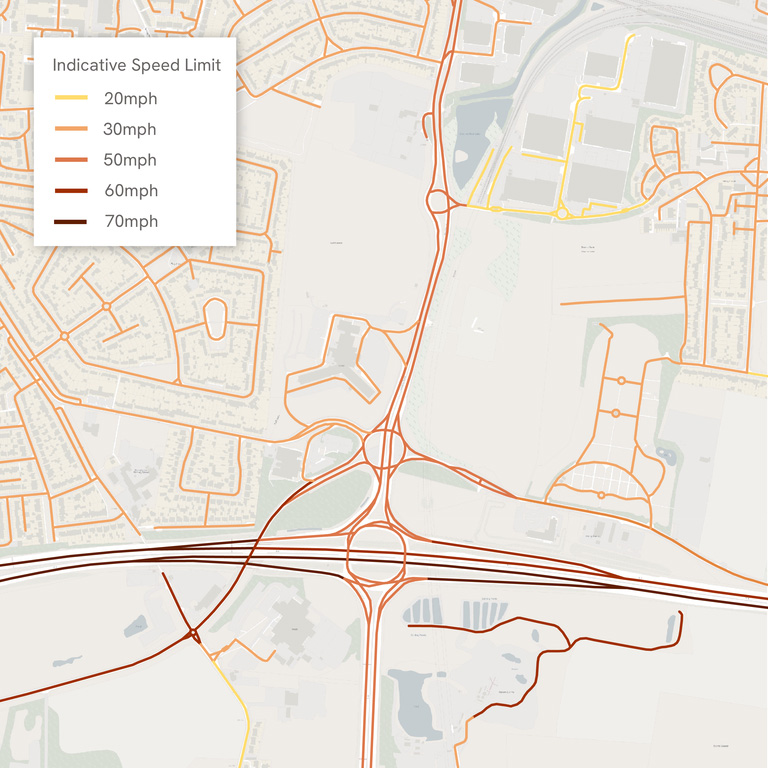
Depicts path network for routing and safety analysis and infrastructure policy decisions.
Product DetailsOS NGD Paths database provides the definitive network dataset of Great Britain's paths. It combines Path Links which are the basic building block of the path network and Path Nodes which are the start and end points of Path Links. In addition named Paths are provided as a collection of Path Links and Connecting Links and Nodes join the path network to the road network.
- Transport Network: provides a topologically structured link and node representation of GB road, ferry and rail networks. Includes road classification, road function, primary routes, road node classification, names associated with the road networks and connectivity between the road network and the ferry and rail.
OS NGD Paths provides all the data and enhancements necessary to perform routing and safety analysis on path networks throughout Great Britain. It also contains a variety of unique identifiers including Ordnance Survey Identifier (OSID).
Technical Details
- Supplier
- Ordnance Survey
- Update Cycle
- Daily
- Coverage
- Great Britain
- Scale
- Large-scale mapping
- Formats Available
- GeoPackage (GPKG), GeoJSON, CSV
- Stated Accuracy
- Survey-grade mapping accuracy consistent with the OS National Geographic Database.
- Stated Accuracy
- Survey-grade mapping accuracy consistent with the OS National Geographic Database.
- Stated Accuracy
- Authoritative large-scale path data maintained by Ordnance Survey and updated as changes are captured. Suitable for mapping and spatial analysis but should be used alongside local rights of way information where legal access is critical.
- Licence Options
- Delivery Timescale
Related Products
Download Samples
OS NGD Transport RAMI
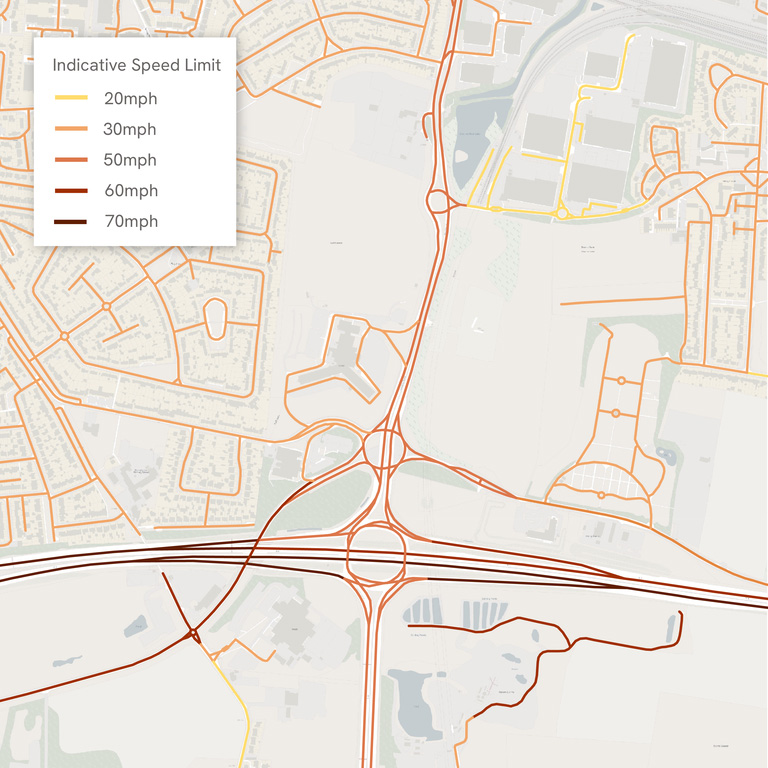
Depicts roads and railways with network restriction for routing and safety analysis and infrastructure policy decisions.
Product DetailsOS NGD RAMI database provides the definitive network dataset and topographic depiction of Great Britain's roads and railways. It combines OS large-scale road and routing information with authoritative information from the National Street Gazetteer (NSG) and the Trunk Road Street Gazetteer (TRSG). It is available in three collections comprised of 37 Feature Types:
- Transport Network: provides a topologically structured link and node representation of GB road, ferry and rail networks. Includes road classification, road function, primary routes, road node classification, names associated with the road networks and connectivity between the road network and the ferry and rail.
- Transport Features: provides individual real-world topographic transport features with lifecycle information (including roads, railways, tramways and streetlights).
- Road Asset Management Information (RAMI): provides detailed routing hazard information (e.g. dangerous bends, low bridges, turn restrictions, time restrictions, one-way streets) and vehicle restrictions (e.g. width, height, weight, length, forbidden vehicle types), plus details for which authority is responsible for maintaining a street, how a street should be restored following works, and conditions that the local highway/roads authority have associated to a street.
Technical Details
- Supplier
- Ordnance Survey
- Update Cycle
- Monthly
- Coverage
- Great Britain
- Scale
- Large-scale mapping
- Formats Available
- GeoPackage (GPKG), GeoJSON, CSV
- Stated Accuracy
- Survey-grade mapping accuracy consistent with the OS National Geographic Database.
- Stated Accuracy
- Survey-grade mapping accuracy consistent with the OS National Geographic Database.
- Stated Accuracy
- Authoritative large-scale path data maintained by Ordnance Survey and updated as changes are captured. Suitable for mapping and spatial analysis but should be used alongside local rights of way information where legal access is critical.
- Licence Options
- Delivery Timescale